What Do You Need to Know in Order to Begin Your Lesson Planning for a Class
A lesson plan is the instructor'southward route map of what students need to learn and how information technology will be done effectively during the class fourth dimension. Then, you tin can blueprint advisable learning activities and develop strategies to obtain feedback on pupil learning. Having a carefully constructed lesson plan for each 3-60 minutes lesson allows you to enter the classroom with more than confidence and maximizes your chance of having a meaningful learning feel with your students.
A successful lesson plan addresses and integrates 3 key components:
- Learning Objectives
- Learning activities
- Assessment to check for educatee understanding
A lesson program provides you with a general outline of your teaching goals, learning objectives, and means to accomplish them, and is by no means exhaustive. A productive lesson is not i in which everything goes exactly as planned, only one in which both students and instructor larn from each other. You may refer to an example of a 3 60 minutes lesson plan here.
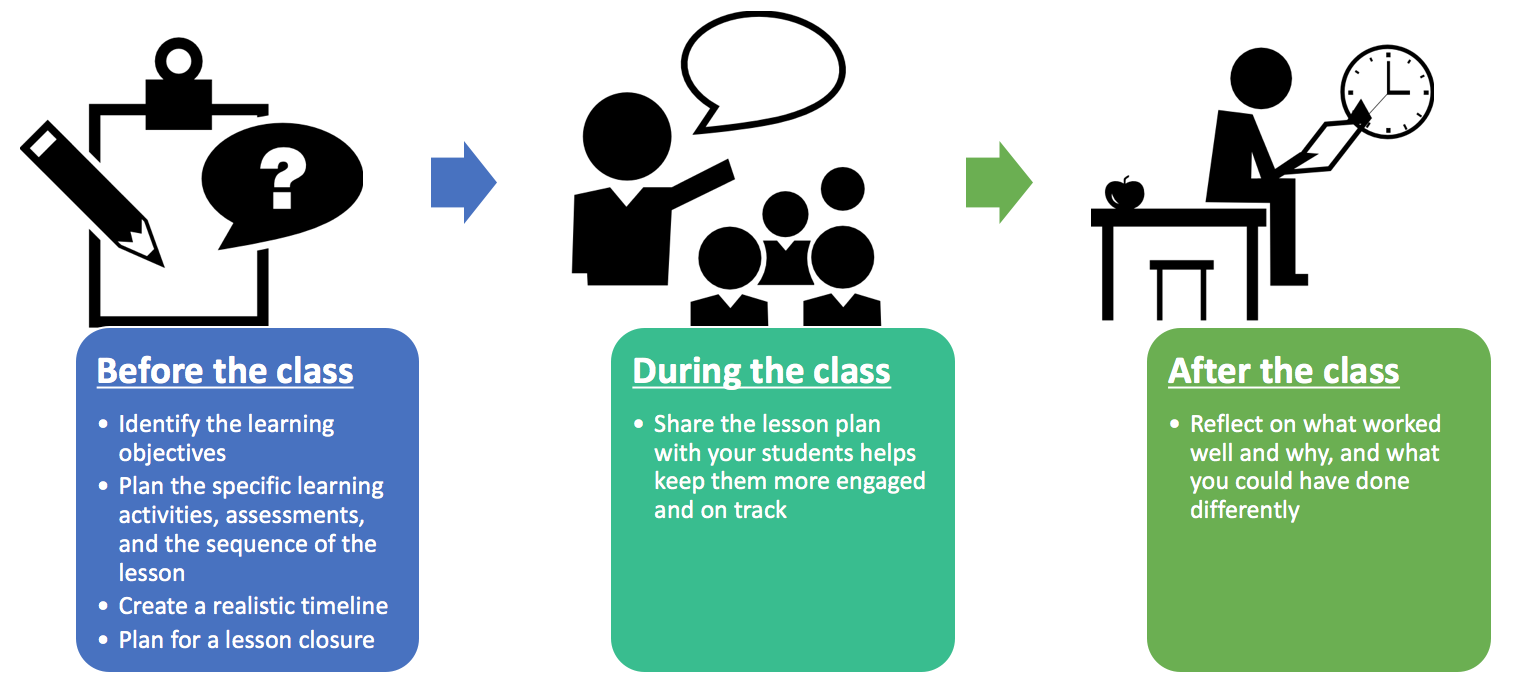
Before Form: Steps for preparing a lesson plan
Listed beneath are 6 steps for preparing your lesson plan before your class.
ane. Place the learning objectives
Before you programme your lesson, you will first demand to place the learning objectives for the lesson. A learning objective describes what the learner will know or be able to practise afterwards the learning experience rather than what the learner will be exposed to during the teaching (i.eastward. topics). Typically, it is written in a language that is easily understood past students and clearly related to the program learning outcomes. The table below contains the characteristics of clear learning objectives:
| Characteristic | Description |
|---|---|
| Clearly stated tasks | Gratuitous from jargon and circuitous vocabulary; describe specific and achievable tasks (such as 'describe', 'analyse' or 'evaluate') NOT vague tasks (similar 'appreciate', 'empathize' or 'explore'). |
| Of import learning goals | Describe the essential (rather than trivial) learning in the course which a student must achieve. |
| Achievable | Tin can be achieved within the given period and sufficient resources are available. |
| Demonstrable and measurable | Tin exist demonstrated in a tangible mode; are assessable; achievement and quality of achievement can exist observed. |
| Fair and equitable | All students, including those with disabilities or constraints, have a off-white gamble of achieving them. |
| Linked to class and program objectives | Consider the broader goals - i.e. course, program and institutional goals. |
The Flower's Revised Taxonomy of Educational Objectives (link) is a useful resource for crafting learning objectives that are demonstrable and measurable.
two. Plan the specific learning activities
When planning learning activities you should consider the types of activities students will need to engage in, in social club to develop the skills and cognition required to demonstrate effective learning in the class. Learning activities should be direct related to the learning objectives of the course, and provide experiences that will enable students to appoint in, practice, and proceeds feedback on specific progress towards those objectives.
As you plan your learning activities, estimate how much time you will spend on each. Build in time for extended explanation or discussion, but also be prepared to move on quickly to different applications or problems, and to place strategies that bank check for understanding. Some questions to think about as you design the learning activities y'all will use are:
- What volition I do to explain the topic?
- What will I exercise to illustrate the topic in a different mode?
- How tin I engage students in the topic?
- What are some relevant existent-life examples, analogies, or situations that tin can help students empathize the topic?
- What will students need to do to help them empathize the topic better?
Many activities tin can exist used to appoint learners. The activity types (i.eastward. what the student is doing) and their examples provided below are by no means an exhaustive list, but volition help you in thinking through how all-time to design and deliver high touch learning experiences for your students in a typical lesson.
| Activity Type | Learning Activeness | Clarification |
| Interaction with content Students are more probable to retain information presented in these ways if they are asked to interact with the material in some way. | Drill and practice | Problem/task is presented to students where they are asked to provide the respond; may be timed or untimed |
| Lecture | Convey concepts verbally, often with visual aids (east.g. presentation slides) | |
| Quiz | Practice to assess the level of educatee agreement and questions tin take many forms, e.yard. multiple-choice, short-structured, essay etc. | |
| Educatee presentation | Oral report where students share their research on a topic and accept on a position and/or role | |
| Interaction with digital content Students experiment with decision making, and visualise the effects and/or consequences in virtual environments | Game | Goal-oriented exercise that encourages collaboration and/or competition within a controlled virtual surroundings |
| Simulation | Replica or representation of a real-world phenomenon that enables relationships, contexts, and concepts to be studied | |
| Interaction with others Peer relationships, informal support structures, and teacher-student interactions/relationships | Debate | Verbal activeness in which two or more than differing viewpoints on a subject area are presented and argued |
| Discussion | Formal/informal conversation on a given topic/question where the instructor facilitates student sharing of responses to the questions, and building upon those responses | |
| Feedback | Information provided by the instructor and/or peer(s) regarding aspects of one'southward performance or understanding | |
| Guest Speaker | Feelings, thoughts, ideas and experiences specific to a given topic are shared by an invited presenter | |
| Problem solving and Disquisitional thinking Presenting students with a problem, scenario, instance, claiming or blueprint issue, which they are then asked to address or deal with provides students with opportunities to think about or utilize cognition and information in new and unlike ways | Instance Study | Detailed story (true or fictional) that students analyse in detail to place the underlying principles, practices, or lessons information technology contains |
| Concept Mapping | Graphical representation of related information in which common or shared concepts are linked together | |
| Real-world projects | Planned set of interrelated tasks to be executed over a fixed period and inside certain toll and other limitations, either individually or collaboratively | |
| Reflection The process of reflection starts with the student thinking about what they already know and accept experienced in relation to the topic being explored/learnt. This is followed by analysis of why the student thinks near the topic in the way they practise, and what assumptions, attitudes and beliefs they accept nearly, and bring to learning nearly the topic. | Reflection journal | Written records of students' intellectual and emotional reactions to a given topic on a regular basis (e.chiliad. weekly subsequently each lesson) |
It is of import that each learning activity in the lesson must be (1) aligned to the lesson'south learning objectives, (2) meaningfully appoint students in agile, constructive, accurate, and collaborative means, and (3) useful where the educatee is able to take what they have learnt from engaging with the activity and utilize it in another context, or for another purpose.
3. Plan to appraise student understanding
Assessments (eastward.g., tests, papers, problem sets, performances) provide opportunities for students to demonstrate and practise the knowledge and skills articulated in the learning objectives, and for instructors to offer targeted feedback that tin can guide further learning.
Planning for assessment allows you to observe out whether your students are learning. It involves making decisions about:
- the number and blazon of assessment tasks that will best enable students to demonstrate learning objectives for the lesson
- Examples of dissimilar assessments
- Formative and/or summative
- the criteria and standards that volition be used to make assessment judgements
- Rubrics
- student roles in the assessment process
- Cocky-cess
- Peer assessment
- the weighting of individual cess tasks and the method by which individual task judgements volition be combined into a final grade for the course
- information well-nigh how various tasks are to exist weighted and combined into an overall class must be provided to students
- the provision of feedback
- giving feedback to students on how to improve their learning, as well equally giving feedback to instructors how to refine their educational activity
To learn more about designing assessment, click hither.
4. Plan to sequence the lesson in an engaging and meaningful manner
Robert Gagne proposed a nine-stride process called the events of instruction, which is useful for planning the sequence of your lesson. Using Gagne's 9 events in conjunction with Bloom's Revised Taxonomy of Educational Objectives (link) aids in designing engaging and meaningful educational activity.
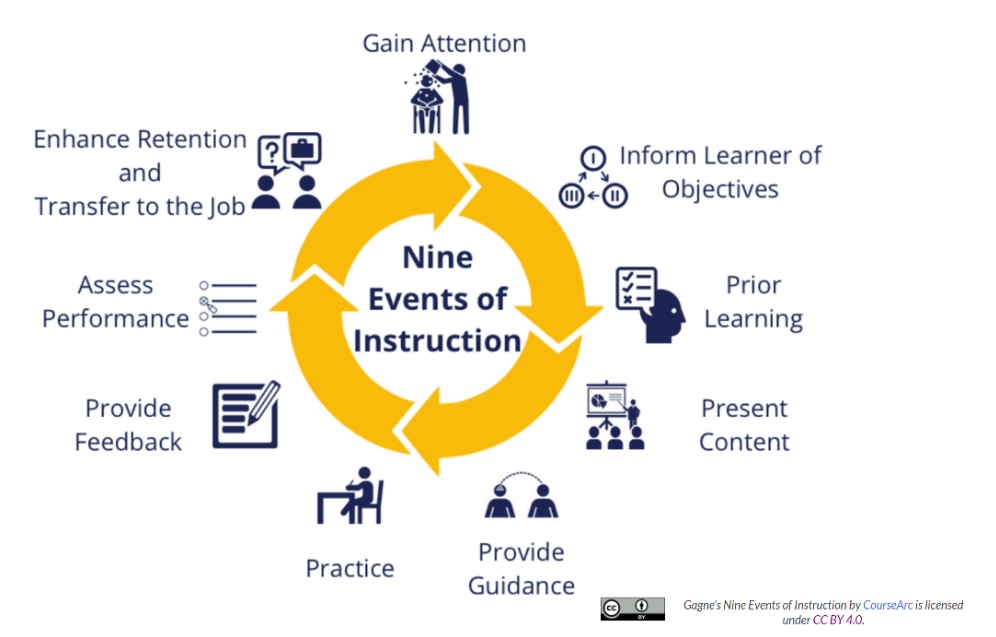
- Proceeds attention: Obtain students' attention then that they will watch and listen while the instructor presents the learning content.
- Present a story or a trouble to be solved
- Use ice breaker activities, current news and events, example studies, YouTube videos, and then on. The objective is to quickly catch student attending and involvement in the topic
- Use technologies such as clickers, and surveys to ask leading questions prior to lecture, survey opinion, or proceeds a response to a controversial question
- Inform learner of objectives: Allow students to organize their thoughts regarding what they are about to see, hear, and/or do.
- Include learning objectives in lecture slides, the syllabus, and in instructions for activities, projects and papers
- Describe required functioning
- Describe criteria for standard functioning
- Stimulate recall of prior knowledge:
- Help students make sense of new data past relating it to something they already know or something they take already experienced.
- Recall events from previous lecture, integrate results of activities into the electric current topic, and/or chronicle previous information to the current topic
- Ask students nigh their understanding of previous concepts
- Present new content: Utilise a diverseness of methods including lecture, readings, activities, projects, multimedia, and others.
- Sequence and chunk the information to avert cognitive overload
- Blend the data to aid in information recall
- Bloom'south Revised Taxonomy can be used to assist sequence the lesson by helping you chunk them into levels of difficulty.
- Provide guidance: Propose students of strategies to aid them in learning content and of resource available. With learning guidance, the rate of learning increases considering students are less probable to lose time or become frustrated by basing operation on incorrect facts or poorly understood concepts.
- Provide instructional support equally needed – as scaffolds (cues, hints, prompts) which can be removed after the student learns the job or content
- Model varied learning strategies – mnemonics, concept mapping, office playing, visualizing
- Use examples and non-examples
To find out more about scaffolding student learning, click hither
- Practice: Allow students to apply cognition and skills learned.
- Allow students to apply noesis in group or individual activities
- Enquire deep-learning questions, make reference to what students already know or have students collaborate with their peers
- Ask students to recite, revisit, or reiterate information they have learned
- Facilitate student elaborations – inquire students to elaborate or explain details and provide more complexity to their responses
- Provide feedback: Provide firsthand feedback of students' performance to assess and facilitate learning.
- Consider using group / class level feedback (highlighting common errors, give examples or models of target performance, bear witness students what you do not want)
- Consider implementing peer feedback
- Require students to specify how they used feedback in subsequent works
- Assess operation: To evaluate the effectiveness of the instructional events, test to see if the expected learning outcomes have been achieved. Performance should exist based on previously stated objectives.
- Utilise a variety of assessment methods including exams/quizzes, written assignments, projects, and so on.
- Raise retention and transfer: Allow students to employ information to personal contexts. This increases retention by personalising information.
- Provide opportunities for students to relate class work to their personal experiences
- Provide additional practise
v. Create a realistic timeline
A list of ten learning objectives is non realistic, so narrow down your list to the two or iii key concepts, ideas, or skills you lot want students to larn in the lesson. Your list of prioritized learning objectives will help you make decisions on the spot and adjust your lesson programme as needed. Here are some strategies for creating a realistic timeline:
- Judge how much time each of the activities will take, then plan some extra time for each
- When you lot fix your lesson plan, next to each activity indicate how much time you expect information technology will have
- Plan a few minutes at the finish of class to reply any remaining questions and to sum up key points
- Plan an extra action or give-and-take question in case you lot have fourth dimension left
- Be flexible – exist ready to adjust your lesson programme to students' needs and focus on what seems to be more productive rather than sticking to your original plan
vi. Plan for a lesson closure
Lesson closure provides an opportunity to solidify student learning. Lesson closure is useful for both instructors and students.
You tin apply closure to:
- Check for educatee understanding and inform subsequent instruction (adjust your teaching appropriately)
- Emphasise key information
- Necktie upwardly loose ends
- Correct students' misunderstandings
- Preview upcoming topics
Your students volition observe your closure helpful for:
- Summarizing, reviewing, and demonstrating their agreement of major points
- Consolidating and internalising key data
- Linking lesson ideas to a conceptual framework and/or previously-learned cognition
- Transferring ideas to new situations
There are several means in which you lot can put a closure to the lesson:
- state the chief points yourself ("Today nosotros talked almost…")
- inquire a student to assist you summarize them
- ask all students to write downwardly on a piece of newspaper what they remember were the primary points of the lesson
During the class: Presenting your lesson plan
Letting your students know what they volition be learning and doing in class volition assistance keep them more than engaged and on track. Providing a meaningful organisation of the class fourth dimension can assist students non but call back amend, but also follow your presentation and understand the rationale backside the planned learning activities. Yous tin can share your lesson plan by writing a brief calendar on the whiteboard or telling students explicitly what they will be learning and doing in class. Click on link hither for tips and techniques to facilitate an interactive lesson.
After the class: Reflecting on your lesson plan
Take a few minutes after each form to reflect on what worked well and why, and what you could have done differently. Identifying successful and less successful arrangement of form time and activities would make it easier to adjust to the contingencies of the classroom. If needed, revise the lesson plan.
Bibliography
- Ambrose, S., Bridges, G., Lovett, M., DiPietro, 1000., & Norman, M. (2010). How learning works: 7 research-based principles for smart teaching. San Francisco, CA: Jossey Bass.
- EDUCAUSE (2005). Potential Learning Activities. Retrieved April 7 2017, from EDUCAUSE website: https://cyberspace.educause.edu/ir/library/pdf/NLI0547B.pdf.
- Fink, D. 50. (2005). Integrated course design. Manhattan, KS: The Thought Eye. Retrieved from http://ideaedu.org/wp-content/uploads/2014/11/Idea_Paper_42.pdf.
- Gagne, R. Yard., Wager, W.West., Golas, Yard. C. & Keller, J. Thou (2005). Principles of Instructional Blueprint (5th edition). California: Wadsworth.
- Gredler, M. Due east. (2004). Games and simulations and their relationships to learning. In D. H. Jonassen (Ed.), Handbook of research for educational communications and technology (2nd ed., pp. 571-82). Mahwah, NJ: Lawrence Erlbaum Associates.
- Richardson, J.C., & Swan. M. (2003). Examining social presence in online courses in relation to students' perceived learning and satisfaction. Journal of Asynchronous Learning Networks 7(ane), 68-88.
- Schuell, T.J. (1986). Cognitive conceptions of learning. Review of Educational Research, 56, 411-436.
Source: https://cte.smu.edu.sg/approach-teaching/integrated-design/lesson-planning
0 Response to "What Do You Need to Know in Order to Begin Your Lesson Planning for a Class"
ارسال یک نظر